
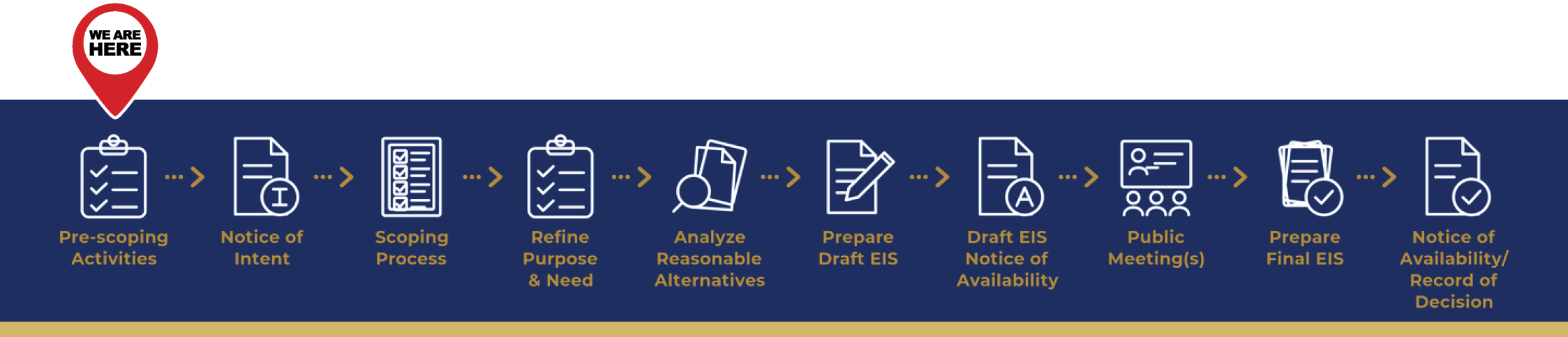
EIS Process and Timeline
Pre-Scoping Activities – In accordance with FAA Order 1050.1G, FAA National Environmental Policy Act Implementing Procedures, during pre-scoping, the FAA ensures that the Proposed Project is ready for environmental review; identifies potential cooperating and participating agencies, coordinates schedule and permitting requirements with each; and develops a preliminary purpose and need statement and project description.
Notice of Intent (NOI) to Prepare EIS – The FAA must publish an NOI in the Federal Register to officially begin preparing the EIS. Publication of the NOI is anticipated in the coming months. The NOI will include an overview of the Proposed Project, the alternatives being considered, and contact information for the responsible FAA official.
Scoping Process – NEPA, as amended by the Fiscal Responsibility Act of 2023, and FAA Order 1050.1G provide for an early and open process to determine the scope of the alternatives to be considered and the issues to be addressed in the EIS. This is a collaborative effort that invites participation from federal, state and local agencies, applicable Native American Tribes, interested stakeholders, and the general public. The public component of the scoping process includes public meetings and the opportunity to comment on alternatives under consideration and the scope of the EIS analysis. Public scoping meetings will be held approximately 30 days after issuance of the NOI.
Purpose and Need and Alternatives Analysis – The purpose and need statement summarizes the problem being addressed, describes what is trying to be achieved, and provides parameters for defining a reasonable range of alternatives to be considered. The FAA will use the purpose and need to establish screening criteria, against which all reasonable alternatives will be analyzed. The alternatives analysis will narrow the range of alternatives to be analyzed in the EIS and also explain why any alternatives were eliminated from further study.
Draft EIS – The Draft EIS will identify the project’s purpose and need and reasonable alternatives, and will evaluate potential direct and indirect environmental impacts that may result from the proposed project and any alternatives carried forward. The Draft EIS is published and made available for public review and comment for at least 45 days. A Notice of Availability of the Draft EIS will be published in the Federal Register. This marks the beginning of the public comment period for the Draft EIS. During the comment period, there will also be public meetings/workshops.
Final EIS – In preparing the Final EIS, the FAA must consider all comments received on the Draft EIS, comments recorded during public meetings, and respond to substantive comments in the Final EIS. The Final EIS must identify and discuss the environmental impacts, including any unresolved environmental issues and efforts to resolve them through further consultation.
Record of Decision (ROD) – The ROD explains the FAA’s decision, describes the alternatives considered, and discusses the FAA’s plans for mitigation and monitoring, if necessary. NEPA, as amended, directs that an EIS be completed within two years of the start of the environmental review (here, publication of the NOI); accordingly, issuance of the ROD is anticipated in 202
About the Proposed Project
The City of San Antonio (City), Aviation Department, is proposing to construct airfield improvements at the San Antonio International Airport (SAT or the Airport), in San Antonio, Texas, collectively referred to as the Airfield Safety Enhancement and Improvements Program (ASEIP or Proposed Project).
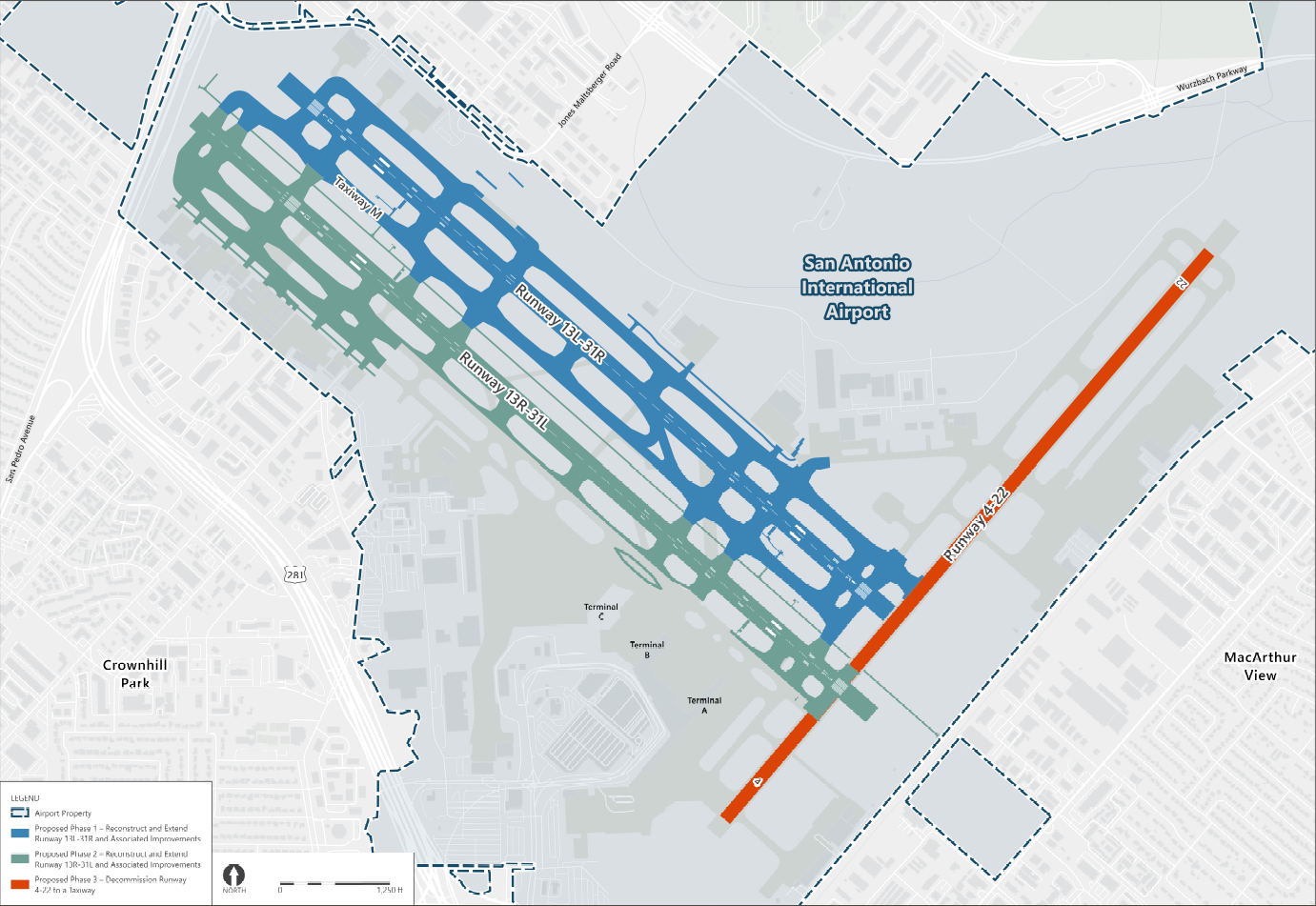
Key components of the Proposed Project include:
Reconstructing and extending Runway 13R-31L
Upgrading Runway 13L-31R for commercial air-carrier operations
Decommissioning Runway 4-22 for conversion to a future taxiway
Additional Components
Taxiway and other airfield improvements
Reconstruction and/or reconfiguration of vehicle service roads
Improvements to associated electrical, drainage, and communications infrastructure
Site preparation activities
Under the Airport and Airway Improvement Act of 1982 and relevant implementing regulations, the Federal Aviation Administration (FAA) must approve changes to an airport sponsor’s Airport Layout Plan (ALP) before construction activities may begin. Approval of the ALP is considered a major federal action, requiring compliance with the National Environmental Policy Act of 1969 (NEPA).
The City initiated an Environmental Assessment (EA) evaluating the Proposed Project in 2025; however, during the evaluation of environmental impacts, the FAA determined that implementation of the ASEIP would exceed FAA thresholds of significance for select environmental resource categories, thereby requiring the preparation of an Environmental Impact Statement (EIS) pursuant to NEPA requirements. Therefore, as the lead federal agency, the FAA is initiating the preparation of an EIS to comply with the provisions of NEPA in accordance with the procedures set forth in FAA Order 1050.1G, FAA National Environmental Policy Act Implementing Procedures, and FAA Order 5050.4B, National Environmental Policy Act (NEPA) Implementing Instructions for Airport Actions.
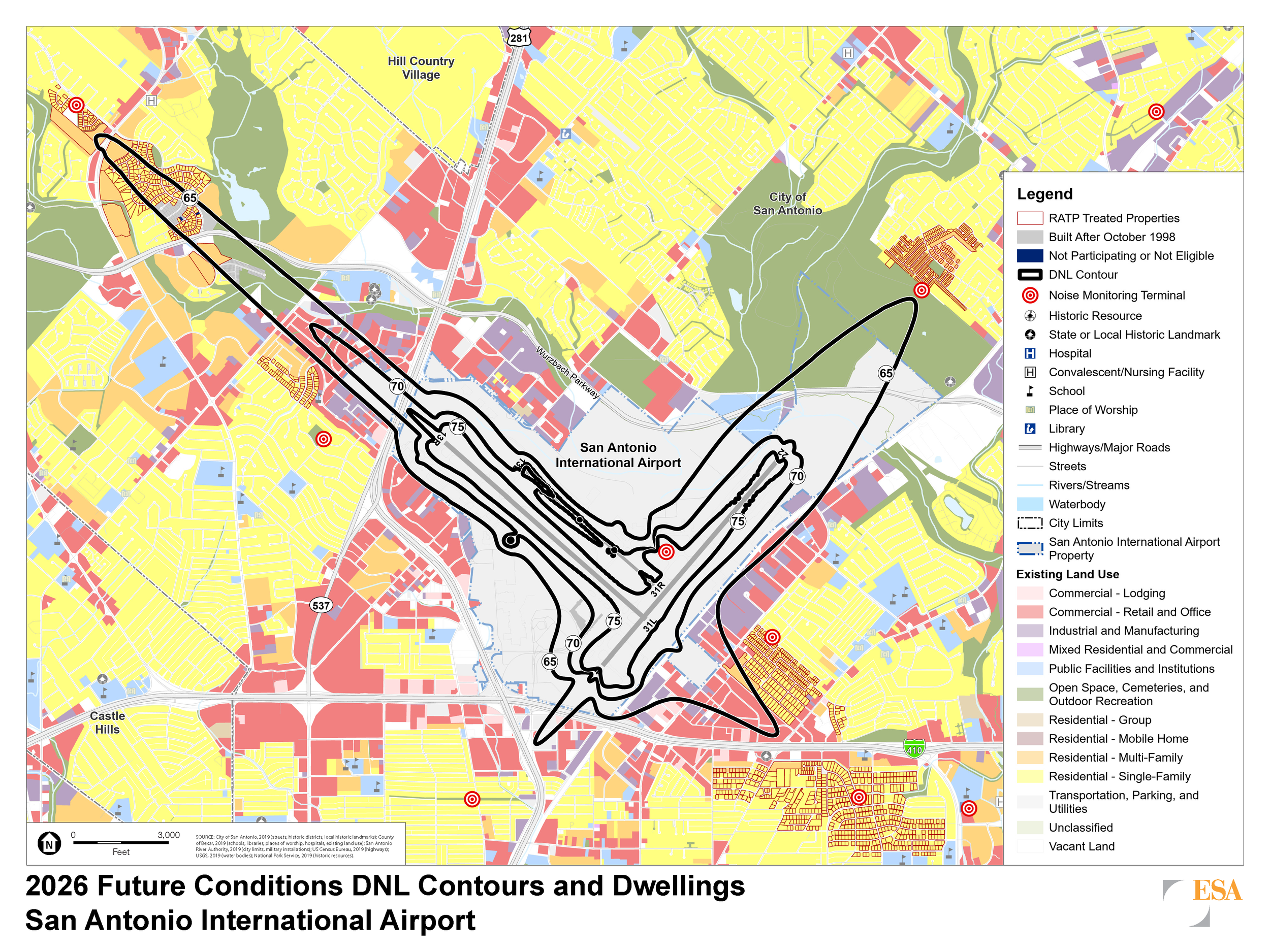
EXISTING
FUTURE
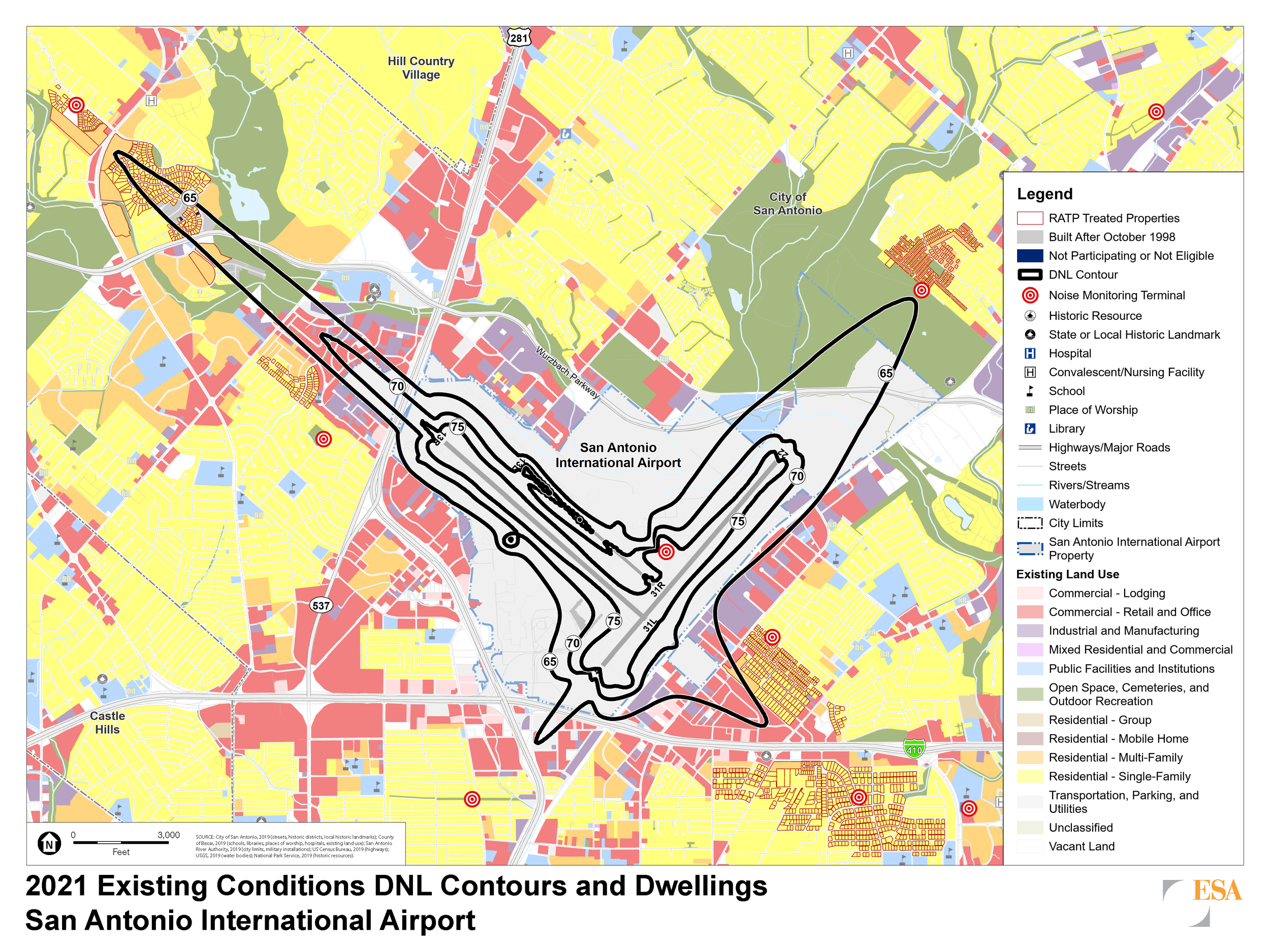
How is this different from SAT’s Terminal Development Program (TDP) that is underway?
Both the Terminal Development Program (TDP) and the airfield improvements evaluated in this EIS stem from SAT's 2022 long-term Strategic Development Plan. The TDP focuses primarily on the airport’s terminal facilities, including passenger buildings, gates, and amenities, addressing the airport's growing passenger capacity needs.
The EIS will evaluate proposed changes to the airfield, including runway and taxiway reconstruction and reconfiguration, navigational aids and lighting, vehicle service roads, and new airspace procedures developed in coordination with the FAA. Previous efforts identified that the airfield improvements met levels that the FAA considered thresholds for evaluation under a full EIS.